1.6 The Umbrella, The Princess and The Teahouse
Art learned about what happened in the forest. A shrine dedicated to a princess who gave birth in fire, And a Teahouse that stood firm amidst decay.
The XO Chronicles
Volume 1 | Chronicle 6
The umbrella.
Black, with a long, hexagon-shaped handle.
Leon carried it the way he carried most things —
without ceremony,
as if it had always been there.
Art, Leon, and H/O2 walked quickly in the rain,
making up for lost time.
H/O2 couldn't help but find Art's floating head
slightly amusing.
Art couldn't help but find Leon and H/O2's escape
a complete mystery.
Leon didn't wonder about anything.
He was still holding the umbrella over H/O2,
his own head and shoulders exposed to the rain,
his head cooler than usual.
Art finally asked:
"Leon. How did you break through?"
Their pace in the rain consistent.
"Thanks to H/O2," Leon replied.
"But how?"
Leon looked at H/O2.
"Just as he said.
He brought me my umbrella."
"And?"
Leon remained silent.
"And," H/O2 chimed in,
"this is no ordinary umbrella."
As the grizzly bear's back hit a large tree,
Art was already through the gap and on his way downhill.
Leon was still in the ring —
dodging, advancing,
running out of moves.
Then, among the thickets of fur and fang,
a white figure appeared.
Moving innocently through the crowd,
a black object in hand,
strides full of determination.
H/O2.
Carrying an umbrella.
Black Thunder saw it too.
He had faced Leon and the umbrella before.
He had prepared for it.
What he had not prepared for
was the fraction of a second
his own formation used
to account for a new variable:
a 1.2-metre robot
that appeared entirely unaware
of the situation it had walked into.
In every formation,
the adjustment to a new variable
creates a gap.
That gap was all Leon needed.
He kicked off a buffalo's ribs,
leaped toward H/O2,
and grabbed the umbrella —
the one he had set down twelve years ago.
His rings and the umbrella lit up together.
He twisted the handle at a precise angle.
The rings' energy ran through the shaft.
The nylon of the canopy melted instantly.
The umbrella became a glowing whip.
Its light reflected in the eyes of every Beast in the formation.
In the eyes of Black Thunder.
Black Thunder felt something he had not felt
in a long time.
Fear.
In the flashes that followed,
a few Beasts were split in different halves.
Others retreated.
The gun troop advanced.
The beasts concentrated into a half circle.
All barrels pointing at Leon and H/O2.
Leon retracted the whip with a twist of the handle.
The umbrella returned to its shape.
The tip was already facing the barrels.
He shifted his grip —
right hand reversed along the shaft,
index fingers touching, charging —
and turned his body ninety degrees,
lifting the umbrella as the voltage peaked.
"Fire," said Black Thunder.
Leon loosened his grip for a fraction of a second,
clenched again —
triggering the discharge —
and opened the umbrella fully.
The shockwave amplified by the umbrella
deflected every bullet.
The deflected rounds went into earth,
into tree trunks,
into limbs,
into eyes.
Several trees fell.
The first five rows of the formation
went out of action.
With the half-circle open
and the formation crippled,
Leon grabbed H/O2 by the waist,
lifted him onto one shoulder,
slung the gear pack onto the other,
and broke through what remained.
The rain had begun to thin.
They reached a signpost at the junction:
五合目 — the Fifth Station marker,
pointing back up toward the mountain.
Leon turned southwest.
Shortly after, an abandoned stable.
There were no horses.
Of course.
The only horse Art had ever met was Black Thunder.
"The mother shrine is in this direction," Leon said,
pointing into a valley where a city once was.
Following the line of his finger,
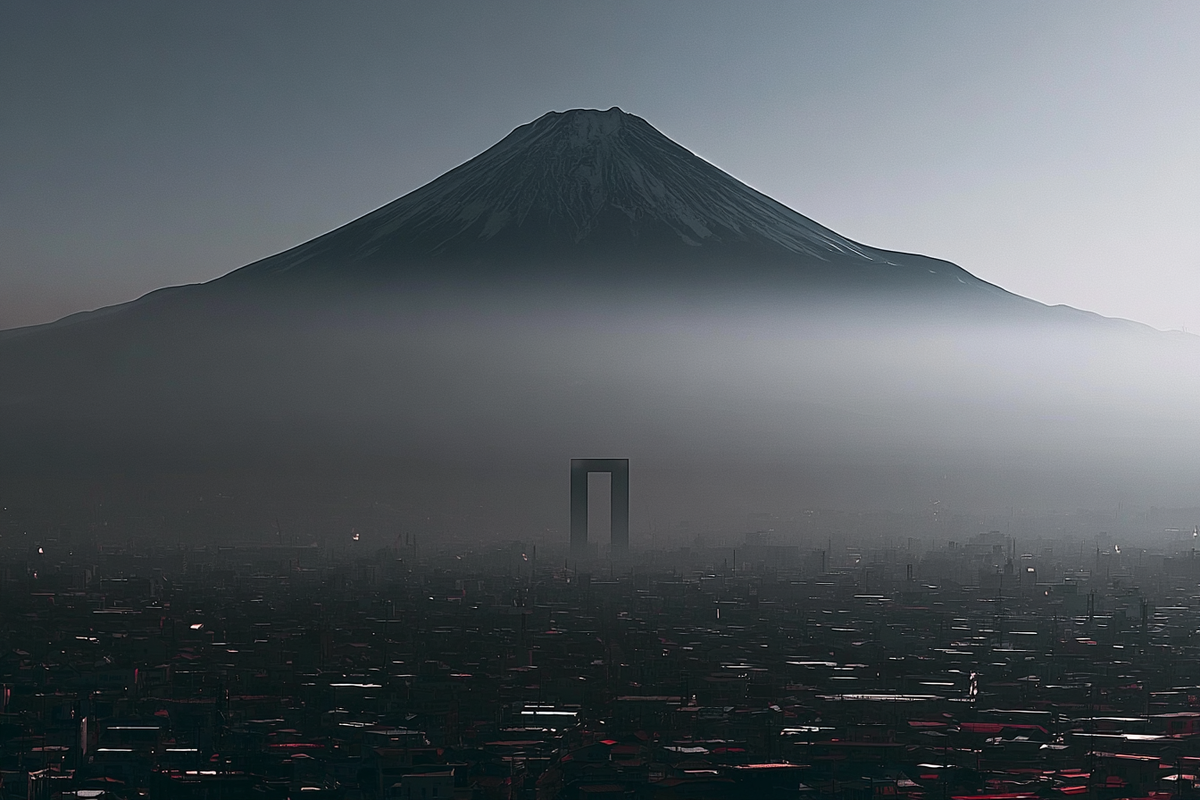
they saw a red torii still standing —
vast and still among the ruins below,
holding its place as it had always held it.
"The Teahouse is in that same direction."
Sunbeams cracked through the thick cloud,
casting light onto the city as if giving it life, hope,
or any one of those positive qualities.
But H/O2 immediately alerted:
"We have approximately two hours
before the outdoor temperature reaches lethal level
for the two of you."
They walked faster,
conscious not to raise their body temperature too much.
The underlayer gear absorbed their sweat completely.
Art walked at twenty percent higher frequency than Leon,
compensating for the height difference.
H/O2 worked harder than either
to match Leon's stride.
As they approached the giant red torii,
even Leon slowed.
They passed through it
in the natural silence
that such gates produce
in those who are paying attention.
The torii was a gateway for the gods —
not a monument for the living,
but a portal the divine used
to pass between worlds.
To walk through it was to acknowledge
that passage.
The Sengen Taisha opened before them.
Low buildings. Stone paths.
Old trees holding their ground in the heat,
indifferent to the decades since anyone came.
This shrine was dedicated to a princess —
Konohanasakuya-hime,
whose name meant she who causes flowers to bloom.
She was the goddess of Fuji,
and of the transient beauty of life.
Her husband had accused her
of carrying another man's child.
To prove him wrong,
she entered a burning parturition house
and gave birth in the fire —
to show that what was true
could not be destroyed by flame.
The child survived.
So did she.
Art did not know this story.
In his world, records of such things
had not survived the Format.
He only felt what the place carried:
something that had refused
to stop mattering.
The stone paths were overgrown.
The lanterns dark.
The offering boxes open to the sky,
empty and unbroken.
Leon paused at one.
He would have done a Gasho,
were he not wearing the rings.
So instead he pushed his right fist
slowly into his left palm —
so the rings would not touch —
and bowed.
Art watched him.
Said nothing.
And followed suit.
In that moment when his head was lowered,
he sensed something —
a disturbance at the edge of his vision,
the way a reflection moves
when the surface shifts.
When he raised his head
to search the inner shrine,
he could find nothing unusual.
Only the silence.
And the faint sense
that the silence had recently changed.
They left the shrine as the heat was rising.
The city opened around them.
Fujinomiya had not been destroyed in a single event.
It had thinned — over years, over decades —
as the wet-bulb hours crept longer,
as the Beasts claimed more of the slopes above,
as the Format dissolved whatever coordination
had kept the remaining residents together.
The last people did not flee.
They simply did not come back.
The signs on the shopfronts were still readable.
Albeit the rusting shutters.
A vending machine stood upright against a wall,
the beverages inside long since evaporated,
the plastic pane warped by decades of heat.
A bicycle leaned in a doorway —
its rubber tires long since melted
onto the concrete beneath,
fusing it to the ground
in a posture of permanent waiting.
They moved through it quickly,
the heat building up with every passing minute.
Beyond the city, a small hill rose.
They climbed it —
the hill of Nonaka,
narrow path, overgrown edges —
and at its crest,
just as they were about to overheat,
the Teahouse appeared.
Low and wide.
Concrete worn smooth by decades of weather.
Its modernist lines unchanged,
its front face plain and quiet,
saying nothing about what it had been through.
Around it, on the terraced hillside,
rows of plants dark and deliberate:
tea, in a strain that had decided
to survive what tea was never meant to.
A low metal gate in black
between concrete walls.
Unlocked.
Stepping stones to a flight of semi-exterior stairs.
They climbed.
Reached the landing.
Leon knocked.
Silence.
He waited — patiently, confidently —
the way he waited for things
he already knew were coming.
And the door opened.
A golden cat stood in the doorway —
accented by sunlight on the earth-tone wall behind it.
Medium-length hair, fluffy enough
to make it impossible to guess its weight.
Large black eyes with a yellow rim.
A youthful pink nose.
The expression of something
that had been alone for a long time
and had come to terms with it completely.
It looked at Art.
Then at Leon.
Then at H/O2.
"Long time no see, Xixi,"
Leon said.
"O-kaeri, Leon,"
Xixi said.
She placed her front paws
back onto the ground
and stepped aside.
next: 1.7 The Cat, The Cause and The Car
to be notified as new contents arrive: